Symptoms that seem unrelated
Skin, breathing, heart, and digestive symptoms that come and go can be hard to describe, and harder to connect.
A patient education bundle from CPHE
When symptoms show up in more than one part of your body and the explanations feel scattered, it is hard to know where to start. This plain-language bundle helps you understand mast cells and MCAS, organize what you notice, and walk into appointments ready for a clearer conversation with your care team.
One-time payment · Four fillable PDFs · Educational resource, not medical advice

Mast cells live in many tissues, so the symptoms people describe often involve more than one body system at a time.
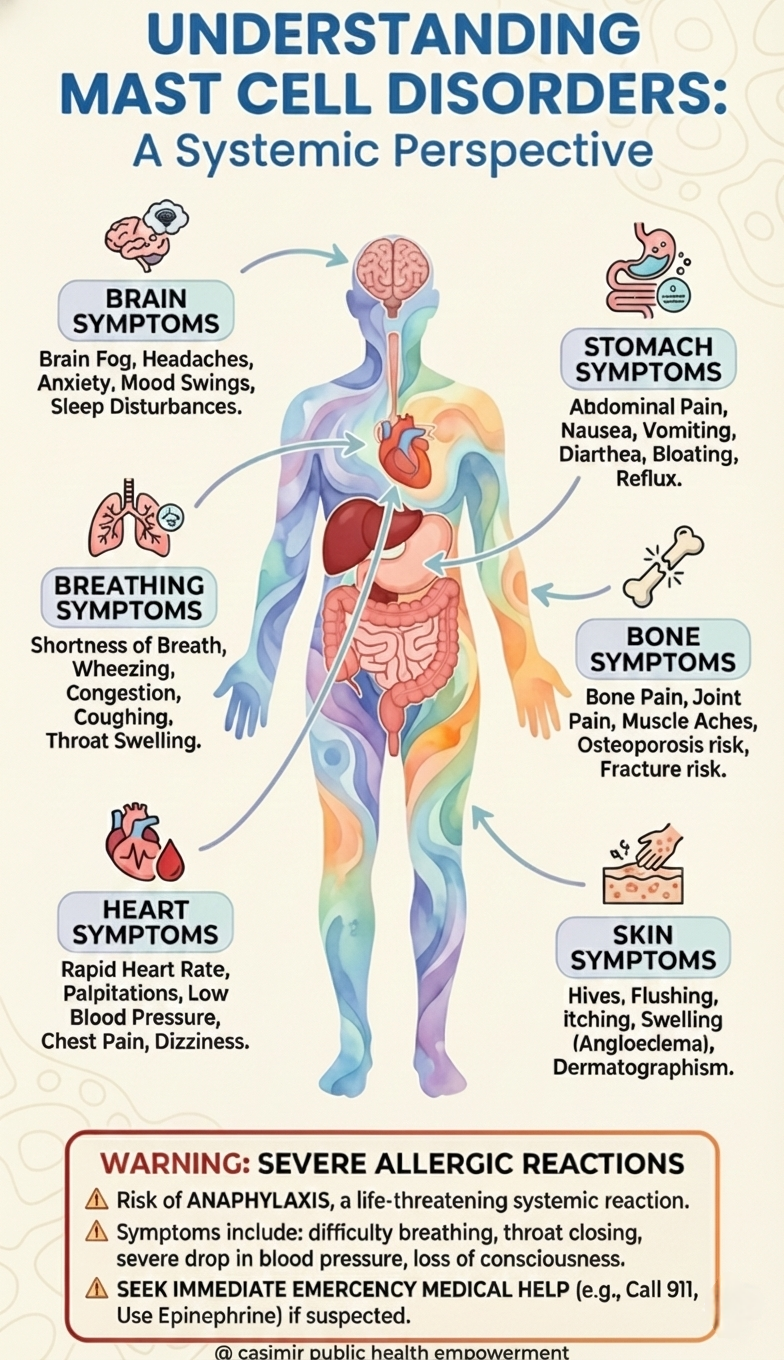
Symptoms like these are shared by many conditions and cannot confirm MCAS on their own. Only a qualified healthcare professional can evaluate and diagnose you.
Many people exploring MCAS describe a long search for answers. This guide was designed to help with the parts of that search you can prepare for.
Skin, breathing, heart, and digestive symptoms that come and go can be hard to describe, and harder to connect.
Online sources often disagree about what MCAS is and how it is diagnosed, which can leave you more confused than before.
It is easy to forget a key detail or question in a short visit, especially when your symptoms are not happening in the room.
Test results, medication lists, and visit notes scattered across portals and paper make it hard to share an accurate picture.
This bundle cannot replace your care team. It can help you understand the landscape and bring clearer, better-organized information to them.

Mast cells are immune cells found in the skin, the airways, the digestive tract, and around blood vessels. When they are activated, they release chemical messengers such as histamine and tryptase.
Mast cell activation syndrome (MCAS) is a condition in which mast cells repeatedly release these messengers in episodes that affect two or more body systems at the same time. Published expert consensus criteria describe three parts that must all be present: typical recurring episodes, lab evidence of mast cell activation during an episode, and improvement with treatment directed at mast cells, assessed by a clinician.
MCAS is still an evolving area of medicine. Experts continue to study how it should be defined in some patients and how it relates to other conditions. That is why this guide clearly separates what experts agree on, what is still being studied, and what patients commonly report.
An important note
The symptoms associated with MCAS are shared by many other conditions. Symptoms alone cannot confirm MCAS, and only a qualified healthcare professional can evaluate and diagnose you.
Four professionally designed, fillable PDFs in CPHE’s brand style. Type your notes and check the boxes on your phone, tablet, or computer, or print them at home if you prefer paper.
PART 1 · 41 PAGES
Ten plain-language chapters on mast cells, MCAS, symptoms by body system, look-alike conditions, how evaluation generally works, treatment conversations, and preparing for care. Includes diagrams, a glossary, trusted resources, and a full reference list.
PART 2 · 9 PAGES
A baseline snapshot, daily and episode logs, weekly and monthly reviews, a photo log, and a one-page summary to bring to your clinician.
PART 3 · 13 PAGES
Plan your goal for each visit, practice a 60-second symptom story, choose your top questions, and track next steps, referrals, and results.
PART 4 · 15 PAGES
Keep contacts, a wallet emergency card, your care team, conditions, medications, allergies, test results, family history, and records requests in one place.
Every worksheet is a fillable PDF. Tap a box to check it, type your notes, and save the file, so your information is with you at your next appointment.


Clinicians look closely at patterns: when symptoms start, which body systems are involved together, and what happened before. The worksheets are built around exactly those details.
STEP 1
Record timing, severity, body systems involved, and possible exposures, and note when any blood or urine sample was collected.
STEP 2
Turn your notes into a short symptom story, a goal for the appointment, and your top three questions, chosen from a bank of sample questions.
STEP 3
Capture what you heard, track tests and referrals, and keep results and records organized for your next appointment.
One-time payment · No subscription or payment plan
No. This is an educational resource. It cannot diagnose MCAS or rule it out. It explains how the condition is generally evaluated and helps you prepare organized information for a qualified healthcare professional, who can evaluate you.
No. The guide describes general categories of treatment that clinicians may discuss so the names are familiar, but it does not recommend any medication, dose, diet, or supplement. Please talk with your clinician or pharmacist before starting, stopping, or changing anything.
The guide draws on published expert consensus statements and professional reports on mast cell disorders, the 2023 anaphylaxis practice parameter, and patient information from organizations such as the National Institutes of Health and MedlinePlus. Every source is listed in the guide’s numbered reference section, and areas where experts disagree are clearly labeled.
All four parts are fillable PDF files. You can type your notes and check the boxes on a phone, tablet, or computer using a free PDF app such as Adobe Acrobat Reader, or Apple’s Files, Books, or Preview apps. Save the file to keep your entries. If you prefer paper, you can also print the pages at home for your own use.
After checkout, the bundle is available in your account on this site, where you can download each PDF.
No. The bundle is a one-time payment of $97 USD. There is no subscription and no payment plan.
Yes. The worksheets are meant to help you share clear, organized information with your own care team. The bundle is licensed for one person’s personal use, so please do not copy, resell, or redistribute the files.
Because this is a digital product you can access and download immediately, all sales are final and refunds are not offered. You will be asked to agree to this policy before completing your purchase. If you have any trouble accessing or opening your files, please contact us and we will help.
Signs can include trouble breathing, throat tightness or a hoarse voice, swelling of the lips, tongue, or throat, or feeling faint. If a clinician has prescribed epinephrine for you, use it as your emergency plan directs. Do not wait to see if symptoms improve, and do not use this guide or website in an emergency.
Medical education disclaimer
Understanding MCAS is an educational resource from Casimir Public Health Empowerment LLC. It is not medical advice, does not diagnose, treat, cure, or prevent any condition, and does not create a patient–provider relationship. Purchasing or using it does not guarantee any diagnosis, symptom improvement, or medical outcome. Always consult a qualified healthcare professional about your health.
Disclaimer · Refund Policy · Privacy Policy · Terms & Conditions
Understand the landscape, organize what you notice, and bring clearer information to the people caring for you.
$97 USD · one-time payment · four fillable PDFs